
Corporate Social Responsibility in Asia Pacific
Deeply dedicated to empowering change in Asia Pacific
Helping shape stronger communities in Asia Pacific
When dedication runs deep, change is possible. Through our CSR programme, we are deeply dedicated to empowering change – for the society of today and generations of tomorrow. Watch these videos to discover how we partner with like-minded organisations to build stronger communities.
Real stories of change from our CSR journey
Education

Providing university scholarships with Yayasan Karya Salemba Empat
Yayasan Karya Salemba Empat (KSE) is a non-profit in Indonesia that provides higher education scholarships to students who need financial assistance. As part of our CSR strategy, Deutsche Bank is dedicated to helping people reach their full potential. We believe that education is fundamental to building stronger communities and work in partnership with KSE to fund scholarships.
At KSE, academics are not the only measure of potential. By supporting essential living expenses through the scholarship, KSE helps reduce financial pressures, allowing students to focus on their studies and thrive.

Delivering financial literacy with The Volunteer Switchboard
The Volunteer Switchboard (VSB) is a social enterprise in Singapore that empowers individuals through volunteerism, character education and financial literacy. Many students enter adulthood without the tools to make informed financial decisions, impacting their long-term stability and success. Deutsche Bank’s CSR education initiative aims to provide the knowledge and competencies to navigate the rapidly changing world and enable personal growth.
We work in partnership with VSB to fund and help deliver financial literacy workshops to young people. Our volunteers serve as role models and facilitators during the sessions, helping students to bridge the gap between theory and real-world application.

Bringing technology into classrooms through Yuva Unstoppable
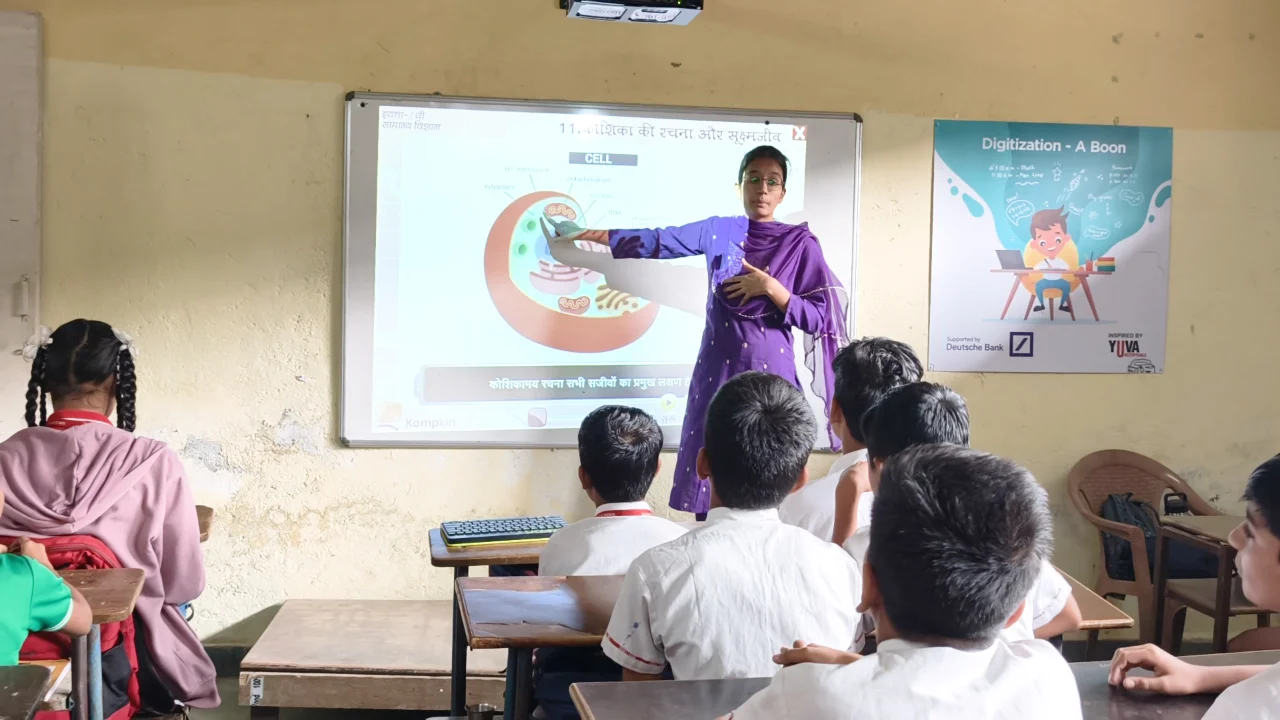
We have collaborated with Yuva Unstoppable in India to support the installation of 100 smart classrooms in government schools in Mumbai, Pune, Bangalore and Jaipur to improve student learning outcomes. Teachers will also be trained to use the digital tools. The blended teaching model will enable teachers to integrate various Information and Communication Technology tools into their pedagogy.
The objective is to foster critical skills like logical thinking, precision, and problem-solving in students. The use of real-world examples through digital content makes lessons more relatable and meaningful for young learners.
Environment

Supporting reef restoration with The Nature Conservancy
As proficient filter feeders, under certain conditions, oysters and other shellfish can filter up to 200 litres of water a day, while the complex structures of shellfish reefs can provide habitat for other marine species and act as physical barriers that reduce wave energy and contribute to coastal resilience. According to The Nature Conservancy (TNC), many of Hong Kong’s shellfish reefs have been lost due to factors including coastal development, dredging, over-harvesting, as well as pollution.
TNC’s goal is to protect 30% of the planet’s oceans by 2030. As part of Deutsche Bank’s CSR environment pillar, we work in partnership with TNC, contributing to their reef restoration programme in Hong Kong to support their conservation efforts.
Other stories of impact
Education

Partnering with Masoom to invest in second chances
Many young people from financially vulnerable families in India are forced to begin working at an early age to help with household finances, sacrificing their education in the process. These jobs are generally physically demanding, unsafe, and poorly paid. Despite their best efforts, the income is never enough to provide financial stability for themselves or their families. This continues even as they grow to adulthood because without proper education and qualifications, they can only obtain low paid daily wage jobs that do not offer job security or long-term growth.
In collaboration with Masoom, Deutsche Bank is supporting the operations of night schools and evening learning centres, as well as fees for short‑term skilling courses to encourage working adults to complete their formal education.
The Masoom pathway also offers these working adults access to structured career guidance and goal planning. Through counselling, they receive help to map their interests to potential jobs and careers. This critical intervention empowers them to support their families safely, with dignity, and plan for the future.
Education helps communities achieve lasting financial security.

Empowering abilities with Sarthak Educational Trust
In India, many persons with disabilities long for independence and a stable income but finding a job can feel overwhelming. Even when they secure interviews, hope often turns to disappointment as communication barriers and repeated rejections erode their confidence. In a country full of opportunity, they are too often made to feel invisible.
Deutsche Bank partners with Sarthak Educational Trust to support their programme to equip Persons with Disabilities (PwDs) with the skills they need to join the workforce. Through accessible, expert-led training aligned to their interests, participants gain industry‑ready skills – including soft skills and digital skills – and are placed in inclusive jobs across IT, retail, marketing, hospitality, and e-commerce. The aim: to help PwDs build sustainable, empowered careers.

Framing Filipino futures with Teach for the Philippines
In a small public school in Cagayan de Oro, 12-year-old Maico struggled to read until a Teach for the Philippines Fellow introduced daily reading circles. Within six months, he proudly read his first story aloud — a small victory that captures the power of investing in teachers and children together, and a reminder that when given the right support, every child can learn and thrive.
Deutsche Bank is partnering with Teach for the Philippines (TFP) to train and deploy 10 Teacher Fellows who will reach 3,000 students in public schools across the country.
TFP’s Fellowship Programme recruits and trains promising individuals to teach for two years in public schools before placing them in government agencies working in education.
Grounded in firsthand experience serving diverse and underserved communities, TFP’s model combines close coaching, mentorship, and communities of practice to build credible, principled leaders capable of transforming education from within.
The goal is to build a long-term pipeline of education leaders while directly strengthening student learning outcomes, giving children from underserved communities a strong start in life and helping break cycles of poverty and inequity.
Environment

Fueling change for women farmers with Centre for microFinance
Through the introduction of resource-efficient farming practices in Dausa, Rajasthan, Centre for microFinance (CmF) in India aims to strengthen capacities of women farmers to increase their incomes while ensuring the judicious use of soil and water resources. Deutsche Bank is supporting their work by funding an initiative to provide 3,000 women farmers with technical and financial support to implement micro irrigation technologies and set up supply chains.
Many women farmers depend on traditional farming practices and livestock for survival. According to CmF, vulnerability to climate events like monsoons, declining soil fertility, inefficient irrigation leading to excessive water use, heavy dependence on chemical fertilisers and firewood; all result in low and unstable incomes. Sustaining their families has become increasingly difficult.
The introduction of interventions like drip irrigation, mulching, organic nutrient management and non-chemical pest control practices have transformed their farmsand and improved the quality of life of their families. Biogas plants, for example, convert animal dung and crop residues into nutrient-rich natural fertilisers and clean cooking energy. This circular system replaces chemical fertilisers and improves soil health. The women can begin to diversify their crops. They reduce their expenses and increase their incomes. The families no longer have to spend hundreds of hours a year collecting firewood for cooking - a physically demanding activity largely carried out by women.
Well-designed interventions help protect farmland and transform vulnerable communities into resilient and economically secure ones.

Supporting community-led syntropic agroforestry with Global Peace Foundation
The Orang Asli are the indigenous people of Peninsular Malaysia. For generations, many Orang Asli communities have maintained close relationships with the forests around them. The forests are not only a source of food and shelter but also hold deep cultural significance to them. Today, some Orang Asli communities face livelihood and environmental pressures associated with deforestation and land development.
Deutsche Bank has partnered with Global Peace Foundation Malaysia (GPF) to help participating Orang Asli communities in Pahang implement syntropic agroforestry, a farming method that mimics the complex interrelationships found in natural forests. It involves the strategic planting of various species and uses practices such as dense planting, vegetation layering, mulching, pruning and the reuse of plant material.
According to GPF, these practices are intended to improve the soil ecosystem and soil health over time. By providing training, on-site mentorship, tools and seedlings, the programme helps Orang Asli farmers to grow diverse crops, supporting food security and income generation.
GPF has reported that since adopting syntropic agroforestry practices, participating farmers are earning higher income while cultivating a variety of nutritious produce that includes lemongrass, cassava, corn, okra, chili pepper, pineapple, banana, soursop, coconut and durian. The farmers reported that this additional income has improved their quality of life.